Why most grand openings underperform
A grand opening is supposed to be the most important day of a new location's life. The single highest-leverage moment to make a first impression on the neighborhood, generate momentum, and lock in early regulars.
For most locations, it isn't.
It's a moderately busy day with a balloon arch.
Why? Because the marketing strategy started too late. Most operators don't seriously begin grand opening marketing until they're 30 days from open. By then, the build-out is finishing, the team is hiring, the systems are being installed, and the marketing budget gets pointed at one tool: paid attention.
Paid attention is fine. But it can't manufacture, in 30 days, what relationship marketing builds in 90: a community that already cares.
That's the whole game. And the difference between a quiet opening and a packed one almost always lives in the pre-launch window — not in the launch day itself.
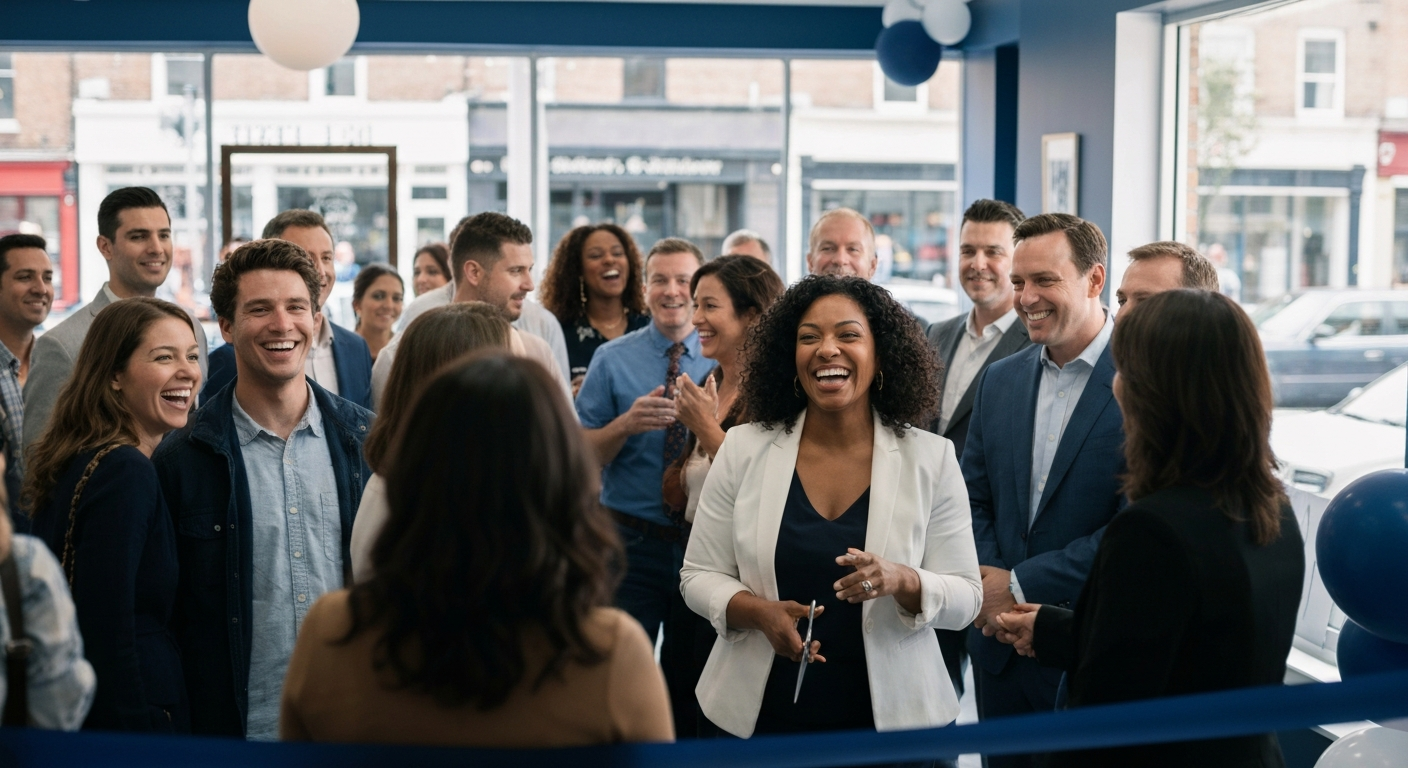
What the best launches do differently
Examples in our field experience reference Day One sales in the $50K–$68K range when the pre-launch relationship work is done correctly. We don't promise those numbers and you shouldn't expect them — but it's worth knowing that days like that don't happen by accident. They happen because somebody put 90 days of relationship work into the neighborhood before the lights ever turned on.
Here's what those 90 days look like.
The 90-Day Timeline
Days 90–60: Map the neighborhood
The work begins by building a Golden Rolodex of every meaningful target within one mile of the new location:
- • Apartment complexes
- • Schools (elementary, middle, high)
- • Churches and child care centers
- • Daycares and preschools
- • Dealerships and auto service centers
- • Fire houses, police, and EMS
- • Hotels
- • Gyms, dance studios, karate studios
- • Office parks and nearby B2B businesses
- • Manufacturers and warehouses
- • YMCAs and youth sports leagues
- • Universities, trade schools, and student groups
- • Nonprofits, libraries, and community organizations
Each entry includes specific people, roles, and the best way to reach them. This is field work — not a marketing-department spreadsheet from a desktop.
Days 60–30: Begin the relationships
Now the Thank You Approach kicks in, with a pre-opening twist:
"Hi, I'm your neighbor. We're opening a new [business] right around the corner in about 8 weeks, and I wanted to come over and introduce myself before the doors are even open. My name is [name]. I just wanted to say thank you for being a great part of this community. Is there any way we can support your team, customers, or organization once we open?"
That single visit is doing the work of a thousand-dollar ad — and doing it better:
- It announces the business exists, without paid attention.
- It positions the business as a neighbor, not a competitor.
- It invites a partnership before there's a transaction to ask for.
- It creates a human reason for that contact to talk about you to their network.
Each contact's response is logged in the Rolodex. Each follow-up is scheduled. Three to five visits a week, fifty visits a month, all running in parallel with the build-out.
Days 30–0: Convert relationships into launch partners
In the final 30 days, the relationships built in the prior 60 become the launch engine.
- The apartment leasing manager hands your launch offer to every new resident.
- The principal mentions you to the PTO.
- The fire house gets a special thank-you delivery on launch week.
- The hotel GM puts your offer in keycard sleeves.
- The partner business across the street cross-promotes to its employees.
- The youth pastor mentions you in announcements.
- The daycare director sends a flier home with parent pickup.
Pre-opening events also get scheduled:
- A partner appreciation preview
- A first-responder soft open
- A teacher preview night
- A leasing manager / property staff sneak peek
By the time Day One arrives, the launch isn't a stranger trying to convince a community to walk in. It's a community walking in to support a neighbor they already know.
Why this works (and why ads alone can't replicate it)
Ads on launch day buy awareness. Awareness brings curious traffic.
Pre-launch relationships build trust and advocacy. Trust brings real intent. Advocacy brings the line out the door.
A 30-day-only launch plan can purchase awareness. It cannot purchase trust. Trust takes time, repetition, and human contact. That's the asset the 90-day window builds.
The launches that produce strong Day One numbers are almost always the ones where dozens of local relationships were already pulling for the business before it opened. The ad campaign was the amplifier — not the engine.
The Grand Opening Engine in five steps
Here's the structure operators can run for any new location, relaunch, remodel, anniversary, expansion, or "second grand opening" of an existing business.
- Pick a target date and treat it like a launch.
- Build a Golden Rolodex 90 days out — every business, school, church, apartment, dealership, hotel, gym, and community organization within one mile.
- Begin Thank You Approach visits 60 days out — three to five visits a week, on a schedule.
- Convert relationships into launch partners 30 days out — flyers, partner offers, preview events, cross-promotion.
- Run paid amplification on top of the relationship base, not in place of it.
What this looks like for an existing business
Most readers aren't opening a brand-new location. The good news: this same engine works for relaunches.
- A remodel reopening
- An anniversary milestone
- A new menu or service line rollout
- A "second grand opening" for a tired location
- An expansion of hours or services
Pick the date. Run the 90-day sequence. Watch what happens when the day arrives and the room is full of partners and the customers they sent.
Common mistakes to avoid
- Starting the marketing 30 days before opening.Too late.
- Treating local outreach as "the marketing department's job."It's the operator's job. The owner or GM has to be in those conversations.
- Skipping follow-up.A first visit without a follow-up is a wasted visit.
- Leading with a pitch instead of a thank-you.Resets the energy in the room from "neighbor" to "vendor."
- Putting all the budget into paid ads on launch week.Ads amplify. Relationships ignite.
The bigger play
The Local Store Marketing & Relationship Building Course includes the full Grand Opening Engine alongside the Smile Lowder Playbook, the A–Z neighborhood targets, the Smile Lowder Method, the Thank You Approach scripts, the Don't Sell — Serve philosophy, the FixAim Local Store Marketing Pyramid, a seasonal monthly guide to LSM, follow-up frameworks, an implementation checklist, and lifetime group access.
It's the system used to engineer launches and relaunches that lead with relationships, not just ad dollars.
See how the Smile Lowder System works"When you do the right thing, for the right reason, you get the right results."
— Jason Lowder