Corporate Marketing vs Local Execution: Why National Ads Can't Replace Neighborhood Trust
National brand-building creates awareness. It does not create local trust. Here's why the location 12 miles down the road is winning — and how to close the gap.
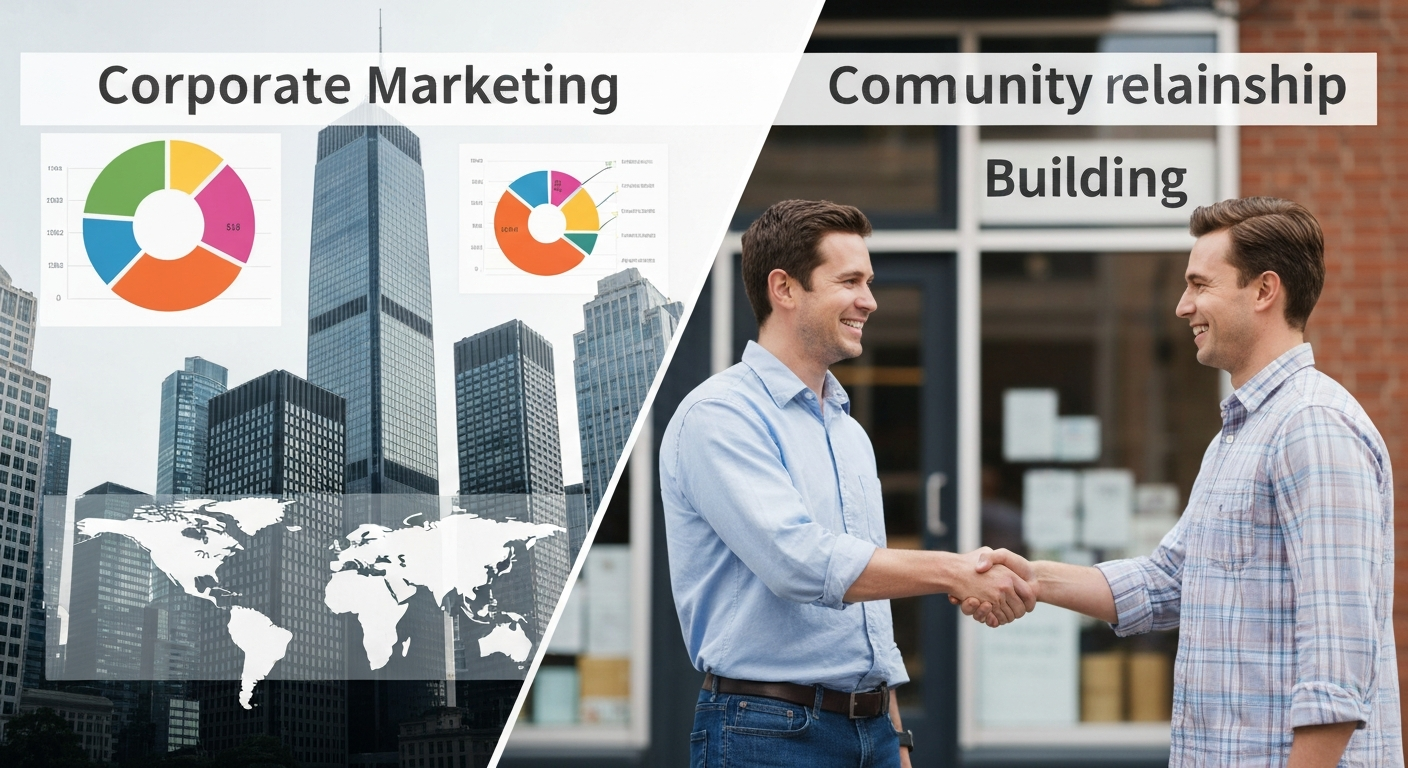
Same brand. Same menu. Different sales.
Walk through any major franchise system and you'll find two locations sitting 10 to 30 miles apart, with the same brand, the same menu, the same operations playbook, the same prices, and the same corporate support — and wildly different sales.
One is killing it. One is struggling.
It's almost never the location. It's almost never the demographics. It's almost never corporate failing one of them.
It's the gap between national awareness and local trust — and the fact that only one of those is corporate's job. The other is the operator's.
Most operators never close that gap, and they never quite understand why the location down the road is outperforming them.
This page is about what the gap is, why it exists, and how to close it.
What corporate marketing actually does
National marketing — TV, paid digital, brand campaigns, sponsorships, PR, programmatic media — does one thing extremely well: it builds awareness.
It plants the brand in the public consciousness. It links the brand to a category. It makes the logo familiar at a glance. It funnels people into "I know that brand exists" territory.
That's a real, valuable, expensive job — and corporate is well-equipped to do it.
What national marketing does not do is build trust at the neighborhood level.
It cannot. The infrastructure isn't there. A national campaign cannot:
- Walk into the leasing office at the apartment complex two blocks from your store.
- Sponsor the school down the street's teacher appreciation week.
- Drop off treats at the fire house two miles over after a tough call.
- Slip a partner offer into the keycard sleeves at the local hotel.
- Cross-promote with the partner business across the street.
- Recognize a returning customer by name.
All of that is local execution work. It happens at the human level, on the ground, in your zip code. And only somebody in that zip code can do it.
The cost of waiting for corporate
When operators wait for corporate marketing to do the work of local execution, the result is predictable.
- The store opens with awareness but no neighborhood relationships.
- The first 90 days underperform expectations.
- Owners increase paid local advertising in panic.
- Paid attention spikes traffic temporarily, then disappears when the budget tightens.
- The "marketing problem" gets blamed on corporate, demographics, or the economy.
Meanwhile, the location 12 miles down the road — same brand, same support, same tools — is quietly executing a relationship strategy. They're walking the one-mile radius. They're running the Thank You Approach. They're stacking partnerships. They're showing up at community events. They're known.
The result, six months in:
The "winning" location has more walk-ins, more referrals, higher repeat-customer rate, and a fuller calendar of partnership opportunities.
The "losing" location is running a third coupon drop and wondering why the numbers aren't moving.
The brand is identical. The execution is not.
The 90/10 problem
If you ask most franchisees what percentage of their marketing is corporate-provided vs locally executed, the honest answer is usually:
- 90% corporate (national ads, brand templates, mailer programs, digital tools)
- 10% local execution (the operator personally building neighborhood relationships)
That ratio is backwards.
Corporate marketing should remain in place — it's a real asset. But local execution needs to become the dominant force in the operator's calendar, not an afterthought.
A healthier ratio looks like:
- 50% corporate-provided amplification
- 50% local relationship execution owned by the operator
The corporate side keeps building awareness. The local side converts that awareness into trust, traffic, and referrals.
What "local execution" actually means
Local execution is not "running the corporate-provided ad creative locally." That's still corporate marketing — just with a smaller budget.
Local execution is:
- Building a Golden Rolodex of every meaningful relationship target within one mile of the front door.
- Walking the one-mile radius weekly using the Thank You Approach.
- Booking partnership-driven events, not coupon-driven events.
- Running a weekly rhythm — visits, follow-ups, appreciation drops — that produces compound relationships over time.
- Tracking every relationship in motion and making sure no contact dies from lack of follow-up.
That work cannot be outsourced upward. Corporate cannot do it. The marketing department cannot do it. Only somebody in the neighborhood, with skin in the game, can do it.
A simple test
If you want to know whether you have a local execution gap, ask one question:
"If my brand turned off all national advertising tomorrow, would my local business still grow?"
If the answer is yes, you have real local equity. The relationships exist. The neighborhood would still produce.
If the answer is no, your growth is leaning entirely on national amplification. Local execution is the gap.
Closing that gap is the highest-ROI work most operators can do — and it's the difference between two locations of the same brand having two wildly different stories.
How to start closing the gap
The work is straightforward, but it has to be done by hand.
- Build the Rolodex. Map every business, school, church, apartment, gym, hotel, office, and community organization within one mile. Specific names. Specific people.
- Block two hours a week for local relationship visits — Monday morning is ideal. Three to five visits per session.
- Run the Thank You Approach at every visit. Lead with gratitude. Don't pitch. Leave something small. Follow up within 48 hours.
- Track everything in a Relationship Tracker — who you met, what you offered, the next step.
- Layer paid amplification on top of the relationship base, not in place of it.
A note for independent operators
If you don't have national marketing behind you, this might sound like a disadvantage. It's actually the opposite.
Without a corporate brand to lean on, you have no choice but to play the local game. The franchisee down the street is distracted by corporate-provided campaigns and waiting for national amplification to deliver customers. While they wait, you build the Rolodex they don't.
In a one-mile radius, the operator who owns the relationships wins. Brand equity helps. It does not decide.
The bigger play
The Local Store Marketing & Relationship Building Course is designed exactly for this gap.
You get the Smile Lowder Playbook, the A–Z neighborhood targets, the Smile Lowder Method, the Thank You Approach scripts, the Don't Sell — Serve philosophy, the FixAim Local Store Marketing Pyramid, a seasonal monthly guide to LSM, follow-up frameworks, an implementation checklist, and lifetime group access.
It's the system used by operators — franchised and independent — to stop waiting for corporate to save them and start owning their neighborhood.
"When you do the right thing, for the right reason, you get the right results."
— Jason Lowder